
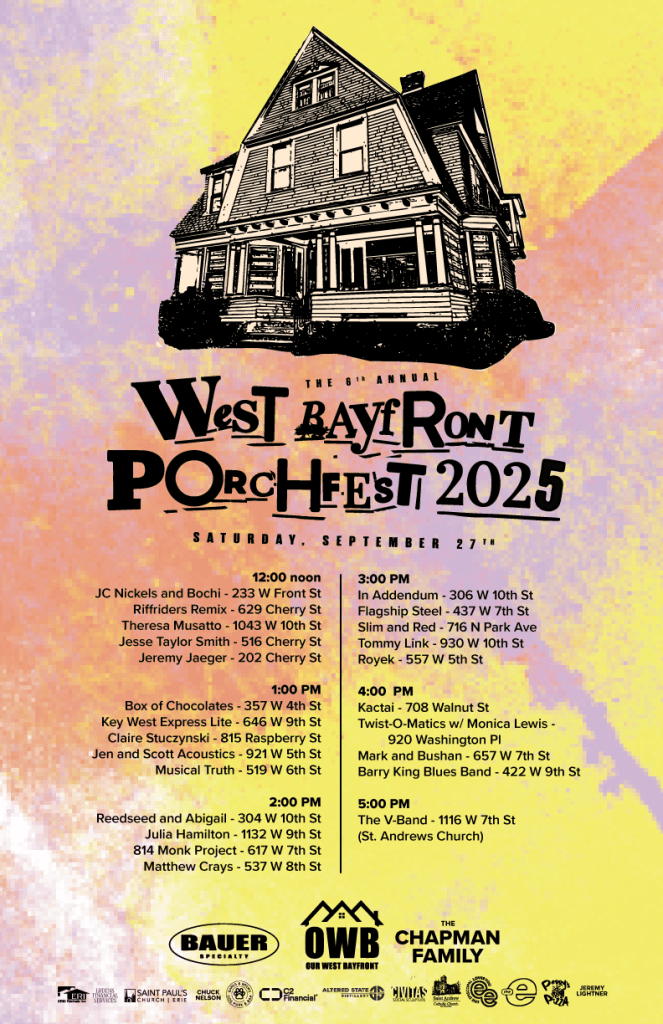
This bike ride was originally written for Our West Bayfront Porch Fest 2024. At the scheduled time, there was a downpour and we were unable to safely ride. As I had a scheduling conflict this year, and since many of these homes will also be hosting a local musical act again this year (2025), I’m including this route as a “Self Guided Porch Fest Bike Ride” for anyone who wants to learn more about some of the homes generously offering up their porches for the afternoon. Or, feel free to take this ride to learn more about these properties at any point! For a full listing of all of the porches and musical acts, visit Our West Bayfront’s website here!
And as always: please feel free to share this information widely, but do not attempt to use this information for personal profit. History can and should be free for everyone!
There is a Google Map of the ride directions here: https://maps.app.goo.gl/SBy48KhM7Z2YdeUz7
Starting out at Gridley Park, our first stop will be along the park at:
716 N. Park Ave. – The Diehl House (in 2025: hosting Slim and Red at 3 p.m.)
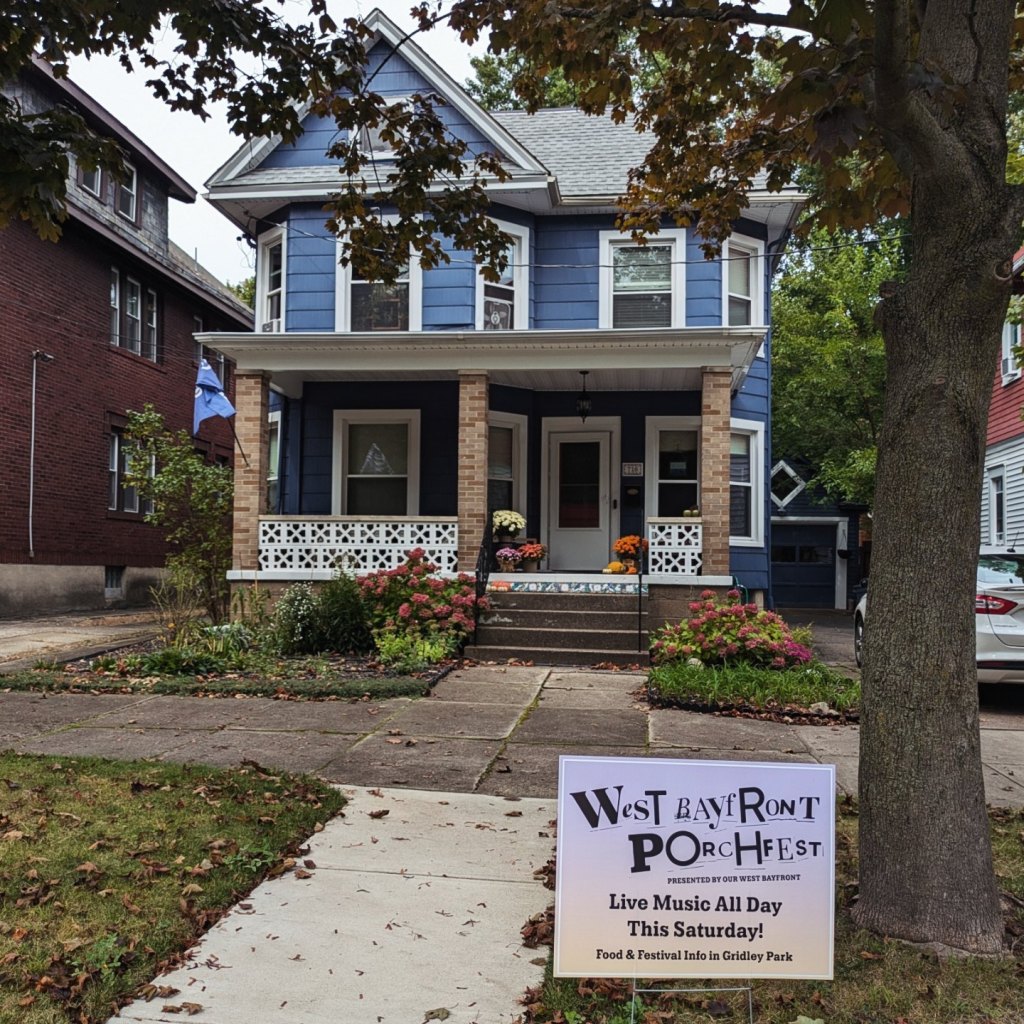
This home was built in 1923. This was once the home of John Christopher Diehl. He was born in Oxford, PA (near Gettysburg) in 1886 and lived at this home with his wife Mary and daughter Marian. He was a veteran of World War I and served as a Captain (Army Corps of Engineers) in the The Meuse-Argonne Offensive (the largest operation of the American Expeditionary Forces in World War I, with over a million American soldiers participating. It was also the deadliest campaign in American history, resulting in over 26,000 soldiers being killed in action and over 120,000 total casualties. It was one of the final battles and led to the eventual armistice).

He was the president of the American Meter Company. He was college educated at Gettysburg and went on to study in graduate school at the Massachusetts Institute of Technology. He won a national award from the Natural Gasoline Association and penned The Natural Gas Handbook which was used as a college textbook internationally.
From here we’ll head north on Liberty, turn right on Fourth and continue east on Fourth to:
357 W. 4th St. – The Boyd House (in 2025: Hosting Box of Chocolates at 1 p.m.)
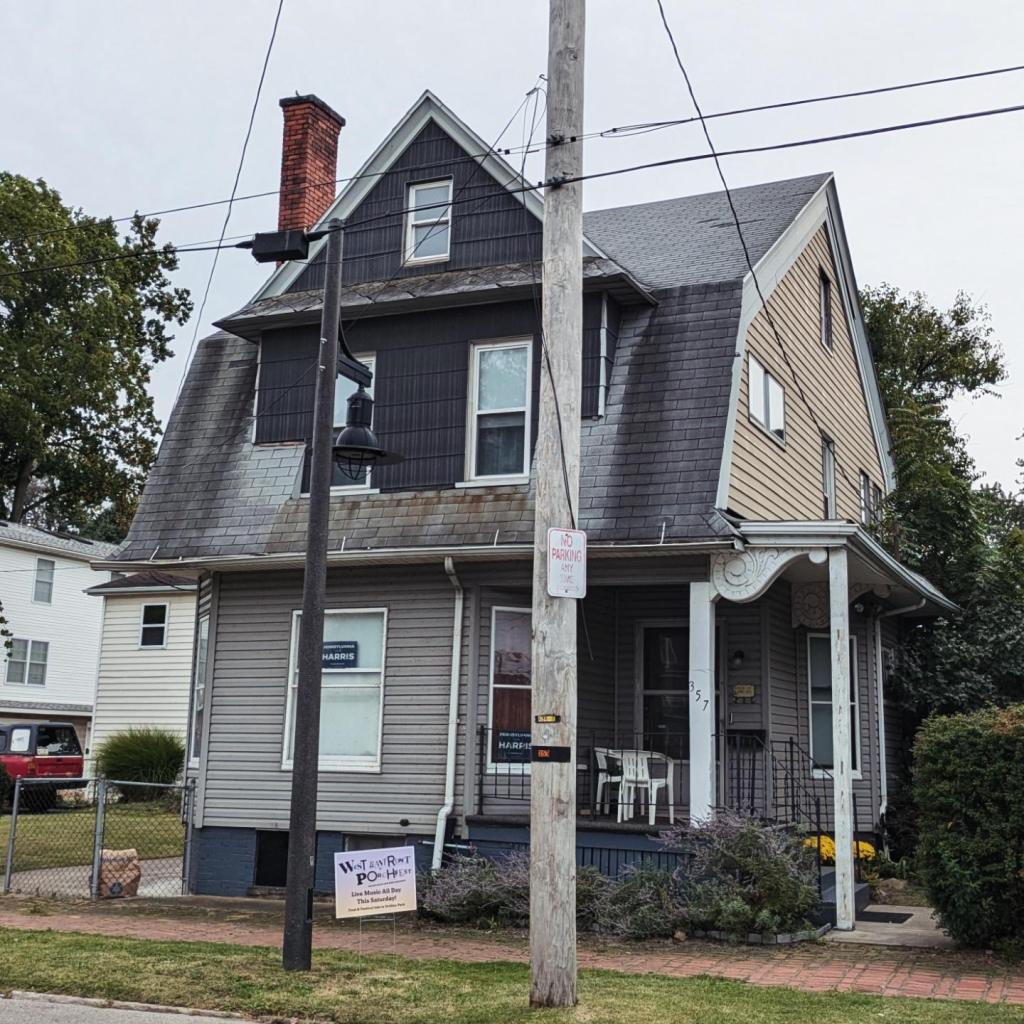
Built in 1900, this was the longtime home of Robert Boyd and Evelyn “Nonie” Hulbert Boyd. The couple inherited the home from Evelyn’s parents, Egbert and Fannie Hulbert. Robert was born in Erie in 1867 to Irish immigrants and owned the nearby grocery store at 4th and Chestnut; he was also a real estate agent. Robert died in 1950 at age 82 and Evelyn lived in the home until 1969 when she died at age 91 (so the home was in the same family for about 70 years). Evelyn was a singer and she regularly led the chorus at St. Paul’s Episcopal.
From here we’ll head south on Chestnut to W. 6th St. and make a left to:
323 W. 6th St. – The William Forster House (This home is not hosting a band in 2025)
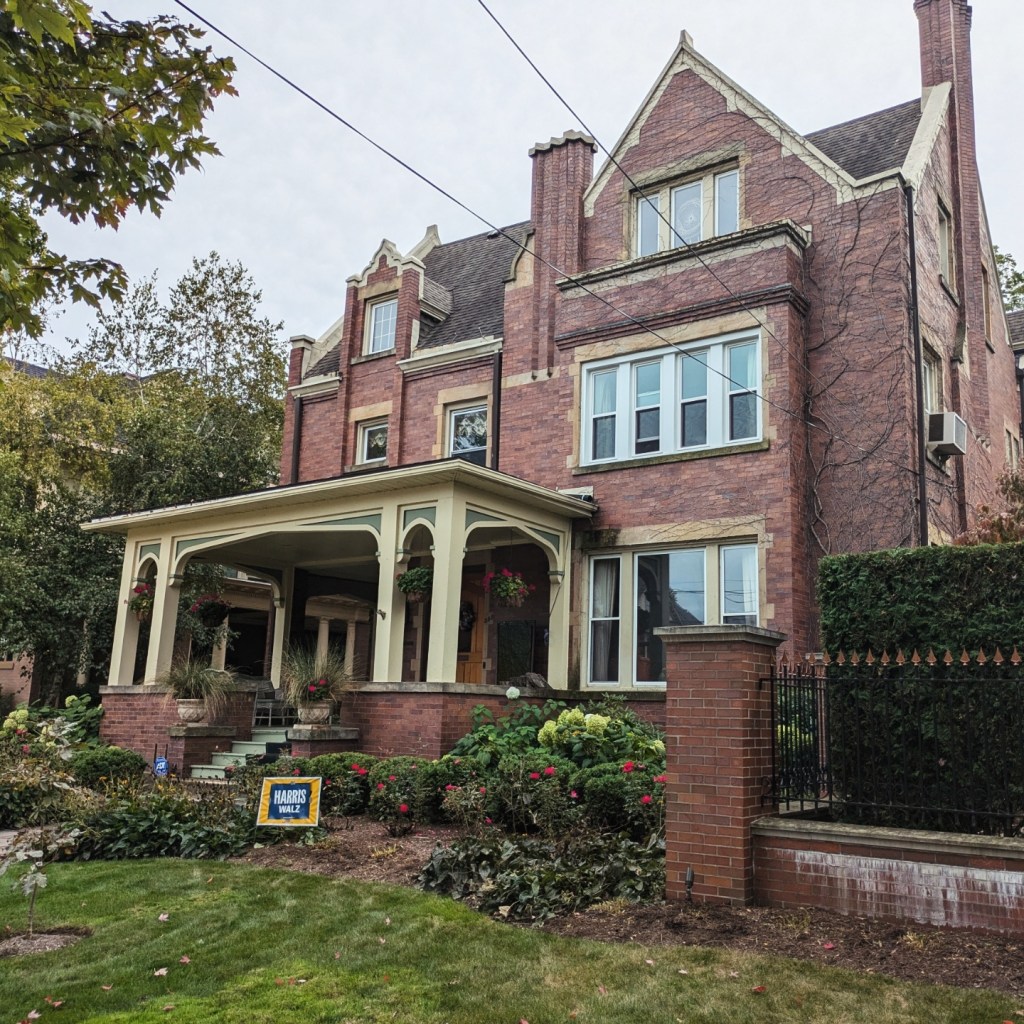
This home was built in 1904 by William Hays Forster, who was the president of the Hays Manufacturing Company. He lived in the home with his wife, Susan L. Forster, his son William Jr., his father Edwin Forster, two servants, and a cook.
William’s grandfather Thomas Forster was a veteran of the American Revolution (and the Whiskey Rebellion). During the War of 1812, he led a volunteer group called the Erie Light Infantry. He owned one of the first sawmills in Erie, was a collector for the port of Erie, and started the Erie and Waterford Turnpike. The Forster family was one of the first to settle in Erie. William Hays Forster served in WWI, graduated from Tufts Engineering College, and eventually took over his uncle’s (John W. Hayes) manufacturing business. He was a man about town, serving on the board of Hamot Hospital, was a member of the Kahkwa, Maennerchor, and Erie Clubs, was director of the Marine Bank, and was a member of St. Paul’s Episcopal.
The lot next door to this home was once the Andrew McMullen House which was torn down in 2014 to create the current Elizabethan style garden and conservatory.
From here we’ll continue east on 6th St. to Sassafras and turn right. Take Sassafras to 10th and turn right to:
304 W. 10th St. – The Erhart House (In 2025: Hosting Reedseed and Abigail at 2 p.m.)
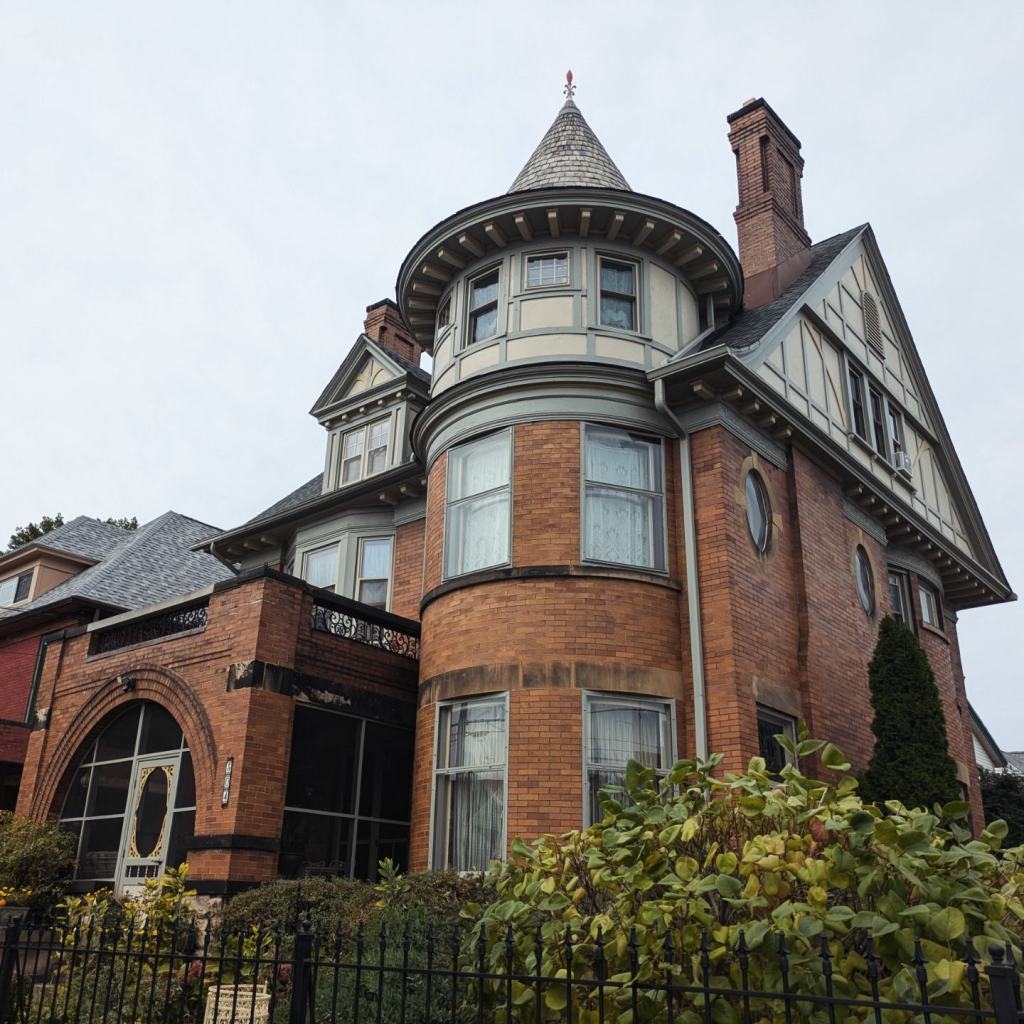
Built in 1905 by the Kirschner Brothers Builders (who were prominent builders around the turn of the century) this home was built for the Erhart family. Joseph Erhart’s family immigrated to Erie from Germany in 1832, were leather workers, and owned a saddle and harness shop behind the Reed Hotel (which was where the parking lot is now, behind the Richford Arms on North Park Row). Joseph served in the Civil War. He moved on up in the leather-working business and eventually owned a fancy leather store at 1305 State Street (luggage, wallets, gloves, etc). Joseph died in 1924, his wife Mary died in 1935, at which point the home passed to Joseph and Mary’s daughter Mary and her husband George Conrath (who worked in gas and oil). Mary Conrath lived in the home until her death in 1963.
From here we’ll turn right onto Myrtle to 9th. Then left on 9th to:
519 W. 9th St. – The Semmence House (This home isn’t hosting a band in 2025)
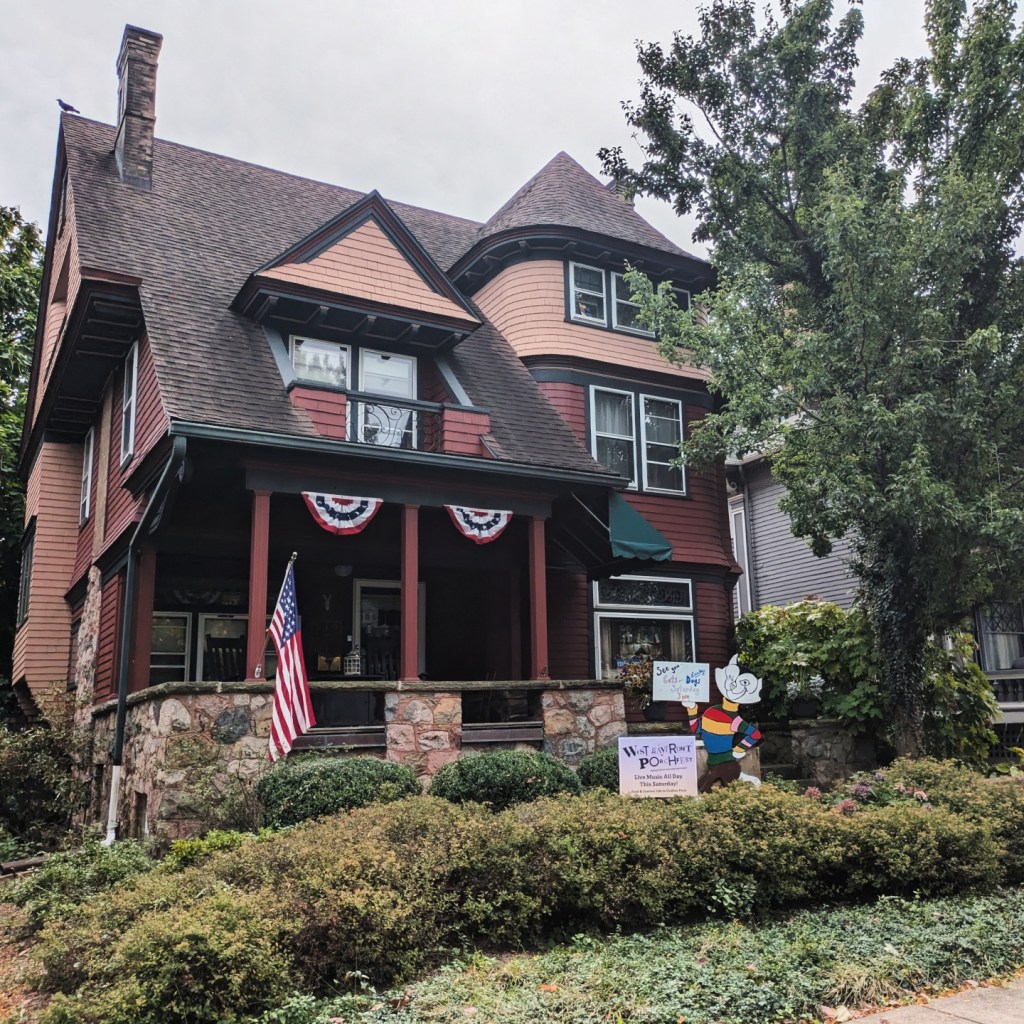
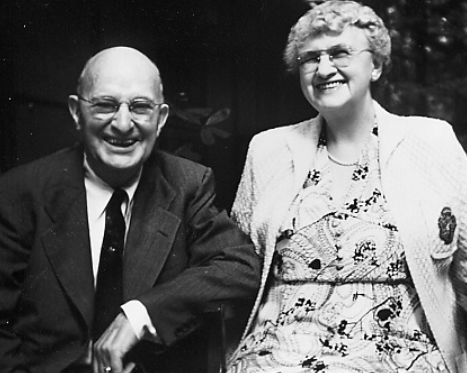
This was once the home of Edwin A. and Minnie Semmence. Edwin was originally from Maryland. He took over the business of the Star Electrical Company on State Street from his father, Edwin, who was a pioneering resident of Erie. Edwin A. was very civically active. He was the chairman of the Erie Chamber of Commerce for a while. Edwin was a boater and was Commodore on a ship called the USS South American which carried 200 Erieites on a four day trip throughout the Great Lakes. They had three daughters that were all extremely bright and graduated from college. Their daughter Edith went on to graduate school and studied Occupational Therapy, working at Water Reed. The family lived here into the 1940s.
While I don’t have documentation to prove it – this home looks very much like it was designed by architect C. Paxton Cody. C. Paxton Cody designed a number of homes and buildings in Erie around the turn of the 20th Century. Some of his most well known designs are the number of Craftsman Style homes he built on Lincoln Avenue. He also designed homes and buildings in Pittsburgh and Cleveland and was the president of the PA State Association of Architects. In this neighborhood, he also designed the church (turned apartments) just south of 9th Street on Liberty. He designed a number of homes along W. 9th Street.
Continuing west on 9th Street, our next stop:
646 W. 9th St. – The Jones Siegel House (In 2025: Hosting Key West Express Lite at 1 p.m.)
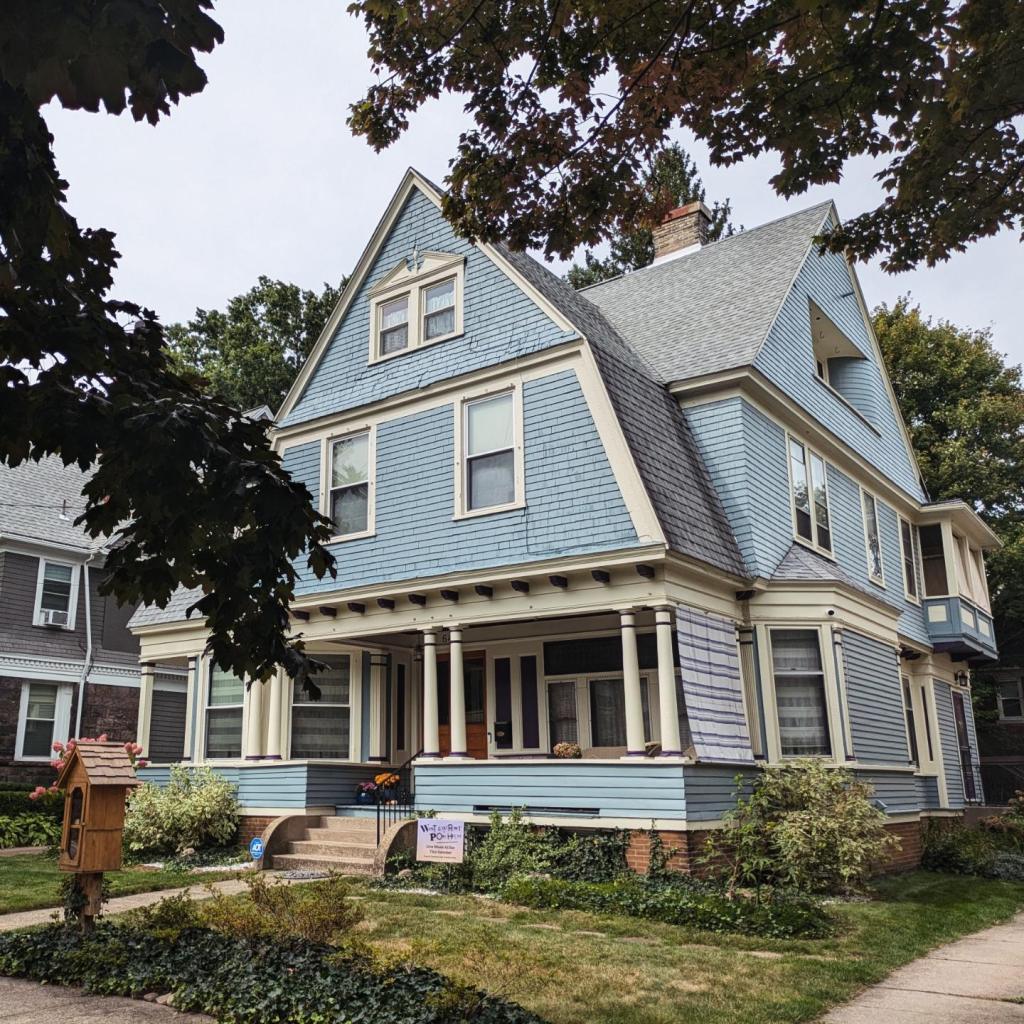
This home was originally occupied by Jesse Supplee, a civil engineer and building inspector for the City of Erie. Eventually the home was purchased by the daughter of Col. Percy Lancelot Jones, who was a U.S. Army Physician as well as the superintendent of Hamot Hospital in the 1930s, and was instrumental in the invention of the ambulance. Elizabeth Jones Siegel and her husband Charles Siegel, who was part of the J.F. Siegel Co. which produced coal and oil, lived in the home for the bulk of its existence, until 2007. Elizabeth died in 2010, at age 94. The architectural style of this house is Shingle style – wood cladding, asymmetry, large, imposing shapes and massing (how large the home appears), gambrel roofs with multiple gables, multiple verandas and porches, cedar shake shingling.
Continuing west on 9th Street to Poplar, head north on Poplar to 7th, then head west on 7th to:
1116 W. 7th St. – St. Andrew’s Church (In 2025: Hosting The V Band at 5 p.m.)
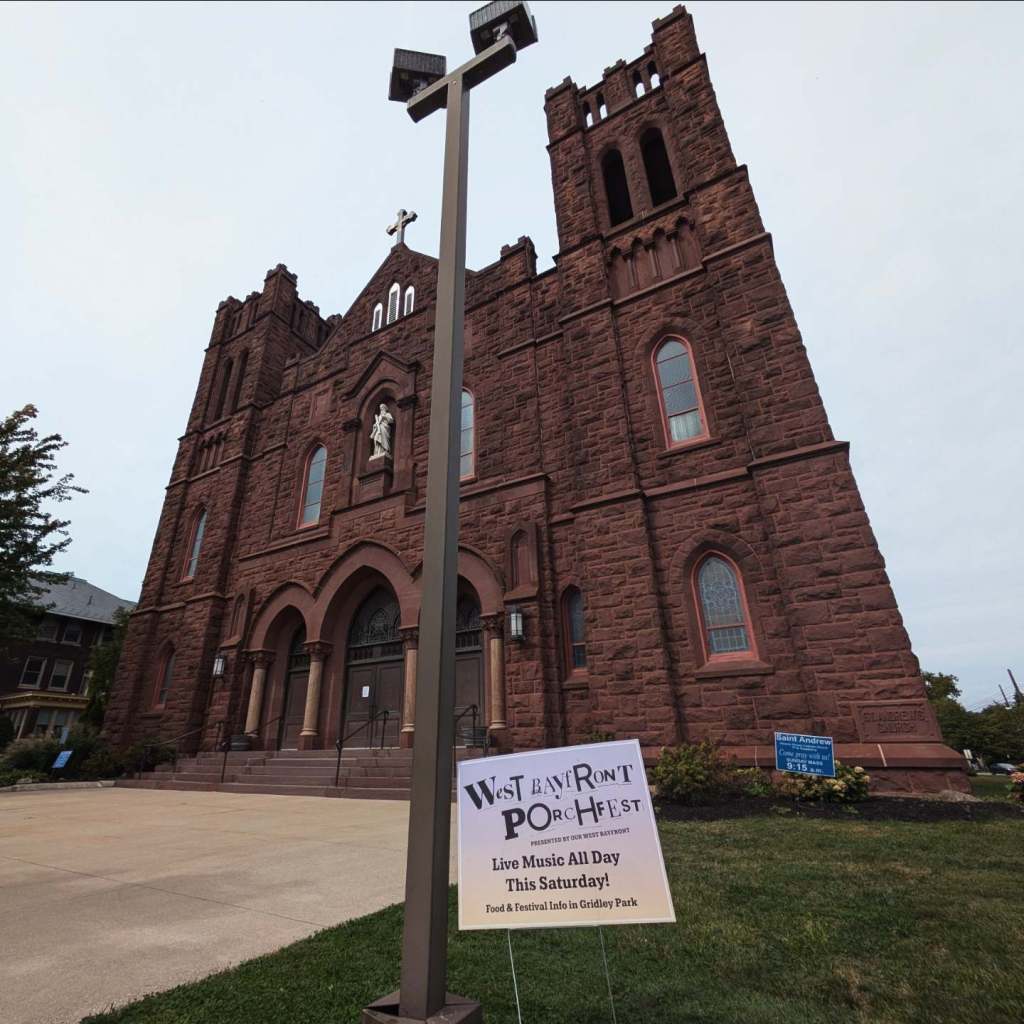
St. Andrew’s Catholic Church is over 150 years old – but this building is about 109 years old as it was built to replace the original structure which was destroyed in a fire. During Centennial celebrations it was discovered that there was a time capsule placed in the cornerstone in 1915. A church publication noted, “The capsule, made of copper and welded tight, withstood the test of time and weather. All of its contents — including the local newspaper headlining the sinking of the Lusitania, a glass bottle containing a handwritten letter from an unknown person from the parish, a Buffalo nickel and other coins, and an assortment of papers and booklets — were dry to the bone.”
The building’s red sandstone exterior with two tall towers is particularly striking. John Mark Gannon, who would later go on to become the Bishop of Erie and namesake/founder of Gannon College, was the parish’s fourth pastor. Saint Andrew school was opened in 1929.
From here, we’ll head north on Raspberry to Sixth and head east, around Gridley Park and South on Cherry. From here we’ll stop at:
629 Cherry St. – The Wicker House (In 2025 Hosting Riffriders Remix at 12 p.m.)
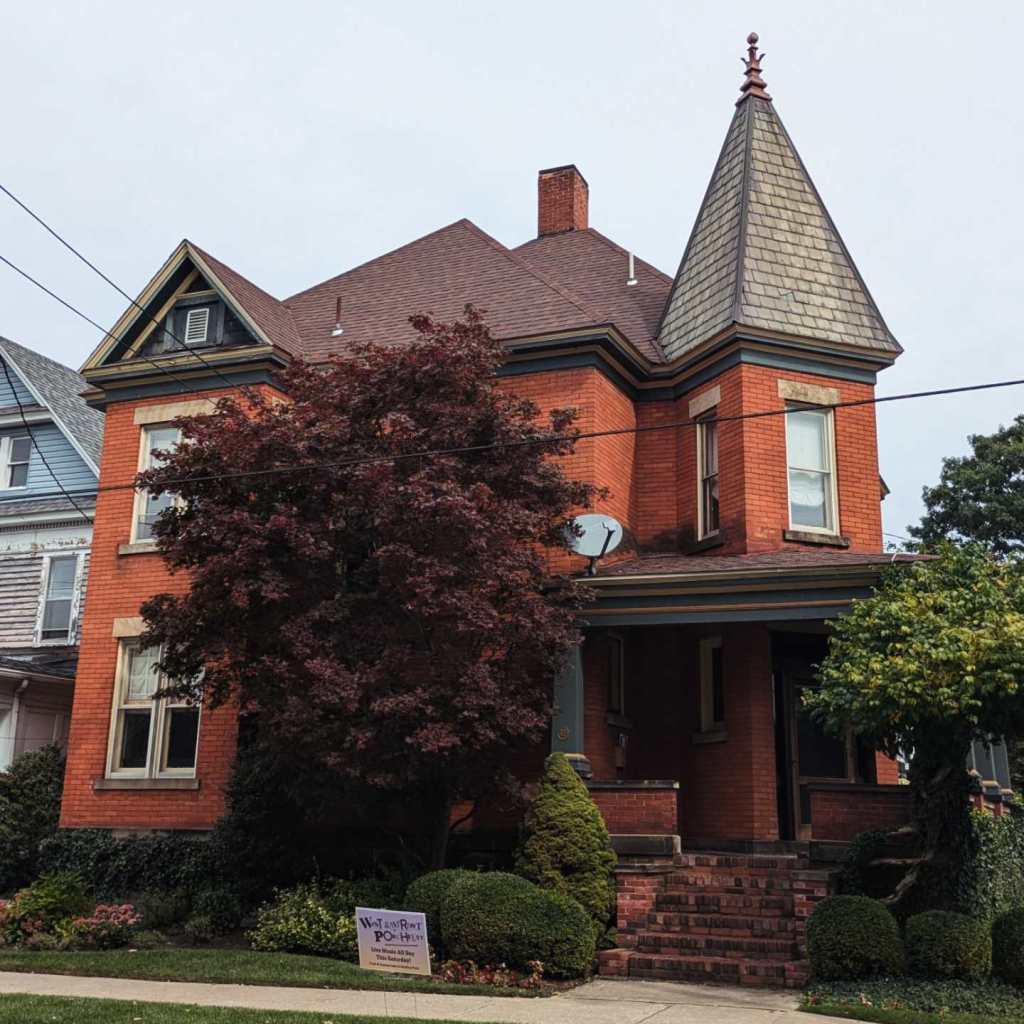
This home has had a LOT of occupants throughout its existence. No one really stayed for long until Walter Wicker.
Built in 1898, one of the first occupants of this house was Ms. Effie G. Johnson. Effie was a spinster and a stenographer at the courthouse for years before she took a job with the William Hayes Company (see William Forster entry above) as a typist. She finished out her career as secretary of the board of health. She moved after about 12 years to 406 W. 4th, where she died. That home has since been torn down. Effie seemed very well loved in the Erie area.
Mr. Walter Wicker was a son of the American Revolution (his great-great grandfather Luther Wicker was born in 1758 in Massachusetts and served in both 1777 and 1779 in the American Revolution and his great-great-great-great grandfather, William Wicker, was on board the Mayflower). Walter served in World War II. He worked for the Lyman Felheim company at 20th and Holland and was super into playing Bridge. His wife, Elinor Bauschard Wicker and was an Erie teacher (taught at Wilson, Strong Vincent, and Wesleyville) and was active in the Woman’s Club, Church of the Covenant, League of Women Voters, and Sarah Reed Children’s home. Elinor died in April of 1969 and Walter died the following December.
Then west on 7th to:
613 W. 7th St. – The Miller House (This home is not hosting a band in 2025)
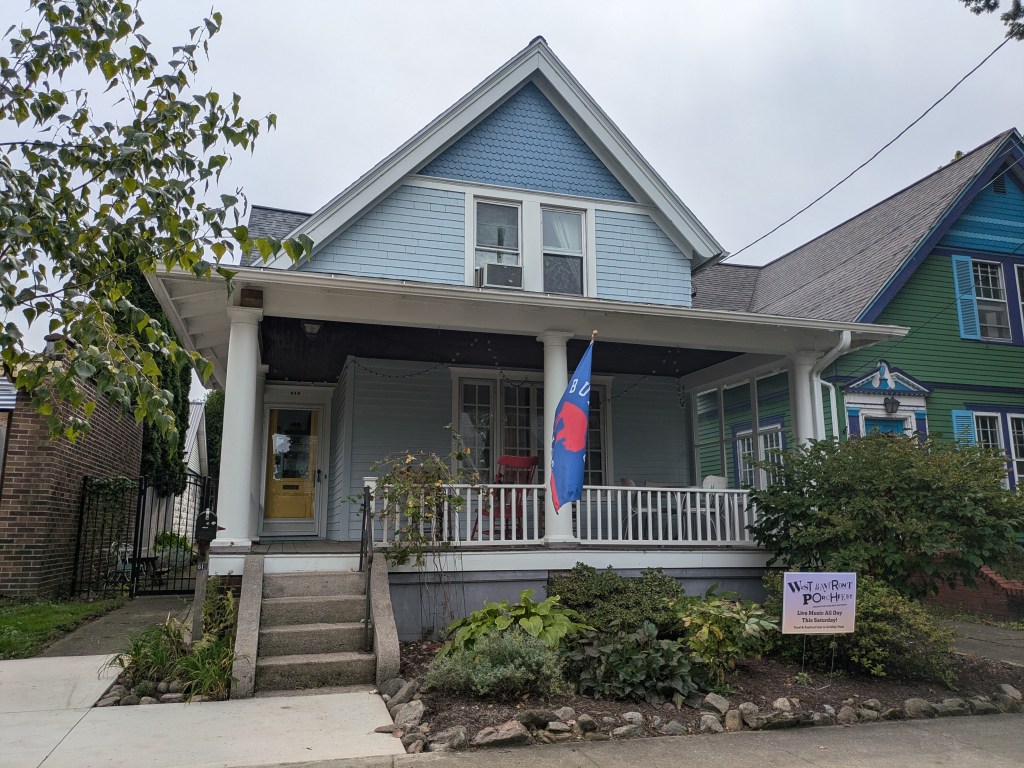
This home was built in 1886 and was originally built as a rental property (I believe by James Baldwin – who eventually developed Garden Court across the street). The 1890 census was destroyed in a fire in the archives in Washington D.C. so access to early census information is impossible, but from newspaper archives I know one of the first occupants of the home was the widow Augusta Miller and her two daughters Emma and Etta. Augusta was married to Charles Mueller/Miller who was a literal flour miller by trade. They had two sons, Charles and Gustave who were both shopkeepers. Gustave was successful and Charles made some poor financial decisions and wound up committing suicide, leaving a wife and young son. After Augusta was widowed she and her daughters moved into 613 W. 7th. Emma was a schoolteacher and eventually a principal. Neither daughter ever married, and after Augusta’s death they moved just down the street to 544 W. 7th St. and the sisters lived with a female boarder named Elizabeth Duncan (a nurse) for decades. It is my assumption that Emma and/or Etta were part of Erie’s early LGBTQIA+ community.
Then west on 7th to:
657 W. 7th St. (In 2025: Hosting Mark and Bushan at 4 p.m.)
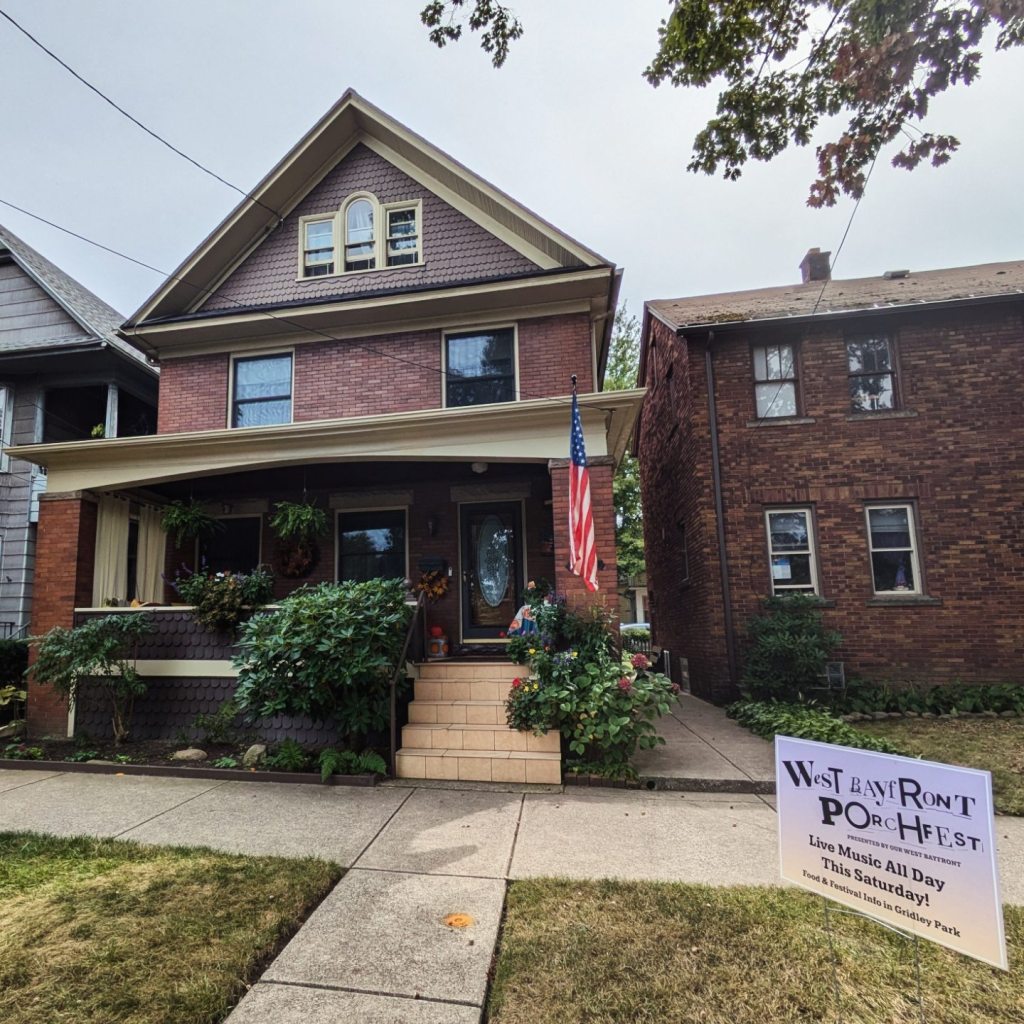
This home was built in 1912 and was originally owned by Dr. and Mrs. (Mary) Noble Chauncey Campbell. Dr. Noble Campbell was born in 1874 in North East and became a dentist. The couple lived in this house for the majority of its early history and the home hasn’t changed hands but three times in its entire history. Noble died in 1943 and Mary continued living in the home until her own death in 1967. Noble’s grandfather was a son of the American Revolution, born in Vermont and moved to North East to farm. Noble was born on that farm. He eventually went to dentistry school at UPenn in Philadelphia. Dr. Campbell’s office was located at 18th and Peach. He and Mary never had any children. He was a charter member of the Zem Zems, the Lawrence Lodge, the Sons of the American Revolution, and the Church of the Covenant.
This house, and neighborhood, has been steadfastly cared for by current occupants Pat and Tom Alterton and Pat’s gloriously talented green thumb is responsible for the construction and maintenance of the central garden and planters within Gridley Park.
From here, riders can head back to Gridley Park to regroup, figure out their route, refuel with some libations from our friends at Erie Ale Works or from some of the local food vendors on hand. If you’ve enjoyed this ride, consider making a donation to Our West Bayfront to continue having events like Porch Fest! And share this route with the friends you meet in the neighborhood!
 olderieonfoot.com
Erin, Thanks for this info! Marilyn
LikeLike