

This was the first historic bike ride I ever hosted/wrote and it was done as a part of Our West Bayfront‘s West Baywalk program, which sponsored themed walks throughout the neighborhood (especially during the pandemic), encouraging neighbors (as well as people from outside the area) to learn a little bit more about their city.
This bike ride was created in a collaboration between Preservation Erie and Our West Bayfront and focused on learning about different architectural styles through observation of the homes in the neighborhood. This can be done as a long walk or a bike ride – I’ll post a map and you can choose your mode of transportation (I’ll also post directions between photos). I would strongly recommend not driving, however. You see and learn so much more moving at a human speed.
I’d love for you to enjoy and learn from the information provided – but please don’t use this information for personal or business profit. History can and should be free for everyone!
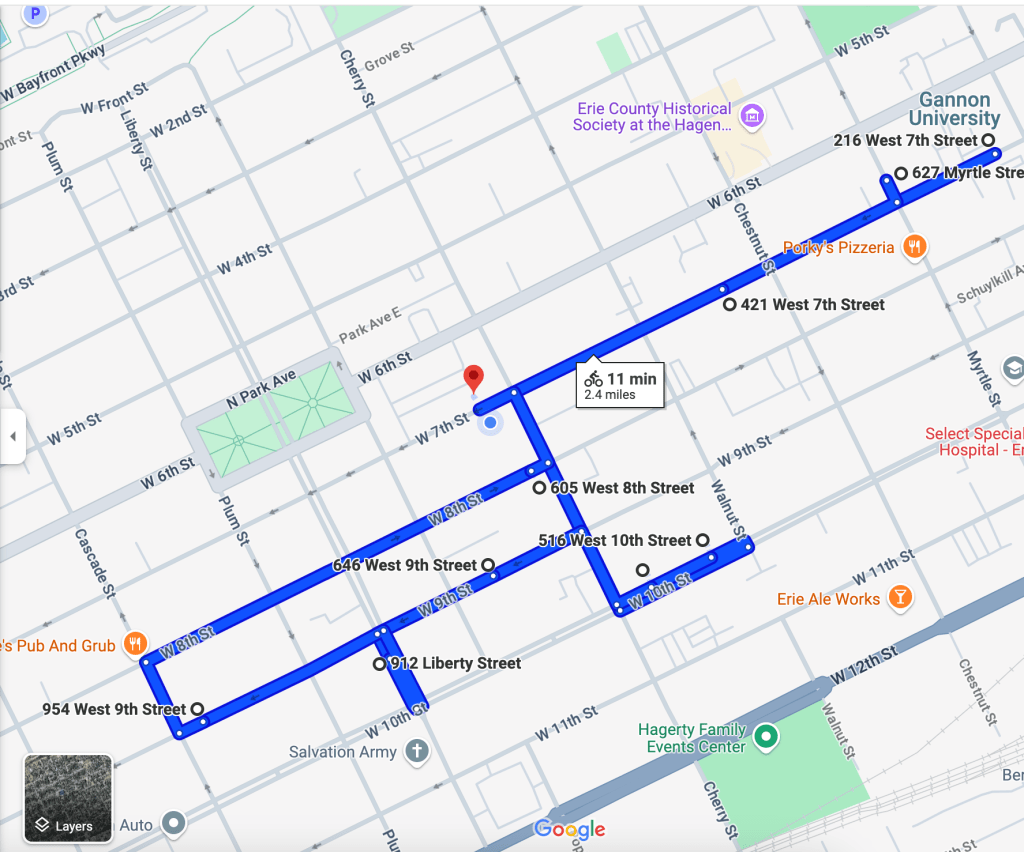
Generally, we start the Our West Bayfront Rides from Gridley Park, as it is a good meet up spot. If you’re doing this ride/walk on your own, you can start at the first extant structure which will be 216 W. 7th Street (but that will also be changing soon). I’ll include the first stop we made in 2021 (which has since been demolished).
216 West 4th Street // The Moses and Matilda Koch House
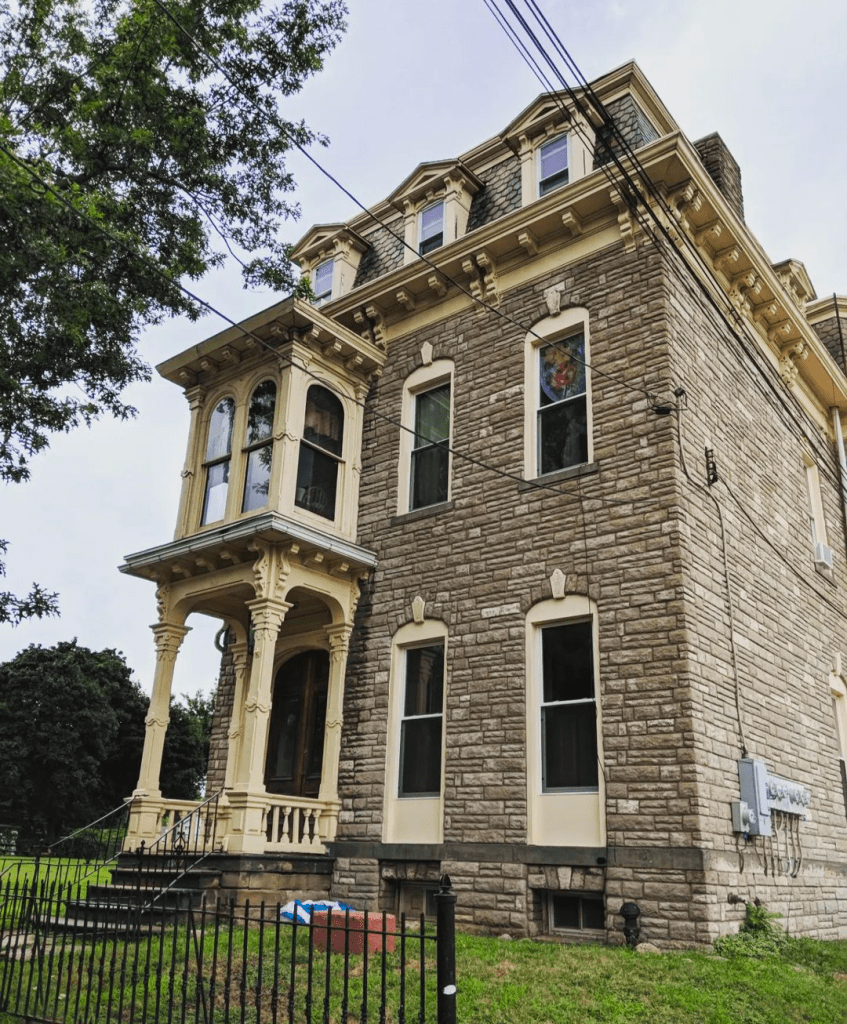
Date of Construction: 1874
Architectural Style: Second Empire
Defining Architectural characteristics: The main feature of a Second Empire home is the Mansard Roof (a four-sided gambrel roof with a shallow or flat top usually pierced by dormer windows), but also the pavilion around the door and upper window (which is a segment of the facade that is different in height or ornamentation than the rest of the building), and the massing (how large the building appears).
History: This was once the home of Moses and Matilda Koch. Moses owned “one of the largest and finest clothing stores” in town within the “Scott Block” on 7th and State with his brother, Jacob Koch. After Matilda’s death in 1897, her daughter and son continued to live in the home until the early 1930s. Once the daughter died (who had no children), the home became apartments.
Update: Demolished in October of 2022
From here, head south on Sassafras Street to Seventh and make a right.
216 West 7th Street // The Olds Norman House
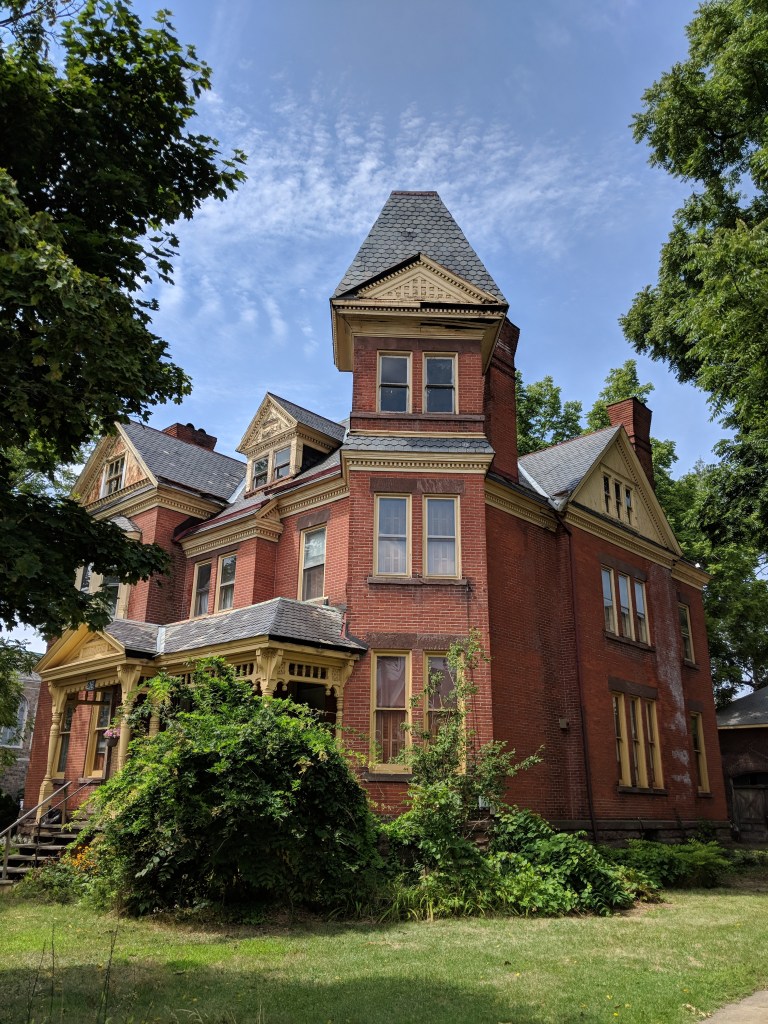
Date of Construction: 1874
Architectural Style: Queen Anne Victorian
Defining Architectural Characteristics: Asymmetrical facade, square tower, a large pedimented porch, different wall textures including shingles and brick, spindle work, bay windows, monumental chimneys, and slate roof. Note: the striking original carriage house (note in 2024: the carriage house has been deconstructed for materials reuse).
History: This home was built by Clark Olds, a successful attorney who was also once the owner of the Park Opera House on North Park Row. It became the long-time home of photographer Ron Norman, who owned the home until September of 2020 when it was purchased by Tom Hagen/Historic Preservation Trust for rehabilitation.
Update: The plan for this home is to move it 180 degrees to the north and have it facing W. 6th Street where Wehrle Hall sits currently. Once Wehrle is demolished – this home will have a new address.
From here, we’ll head around the corner, north half a block on Myrtle.
627 Myrtle Street // The Wingerter Kirk House

Date of Construction: 1920
Architectural Style: Craftsman
Defining Architectural Characteristics: Low pitched roofline, deeply overhanging eaves, exposed rafter tails under the eaves, wide front porch, tapered square columns supporting porch roof, earth tones (especially on roof), stone work (in this case, river stone) and mixed materials throughout.
History: This is Gannon’s Kirk house. Kirk is the Scottish word for Church, making this home the “Church House,” providing living quarters for religiously committed Gannon students. The home was originally occupied by G.B. Wingerter, owner of Wingerter and Sons, a successful tobacconist and cigar maker in Erie on Turnpike Street.
From here, continue west on Seventh Street.
421 West 7th Street // The Derry House

Date of Construction: 1896
Architectural Style: American Foursquare
Defining Architectural Characteristics: Pyramidal roof, boxy design, center dormer (often on all four sides), large front porch. This home also features “clinker bricks.” Clinkers were the result of bricks being kept too close to the heat source in the kiln. Their appearance is darker and less uniform in color, and the brick shape is often irregular. The term “clinker” refers to the sound these make when banging together.
History: The home was originally occupied by the Derry Family. Ed Derry incorporated the Penn Art Steel Company which made steel products for office, hospital, and hotel use (like wastebaskets).
Turn back east (on the sidewalk – Seventh is one way headed west) and turn south onto Chestnut. Take Chestnut to 10th and turn right.
516 West 10th Street // The Davis Illig House
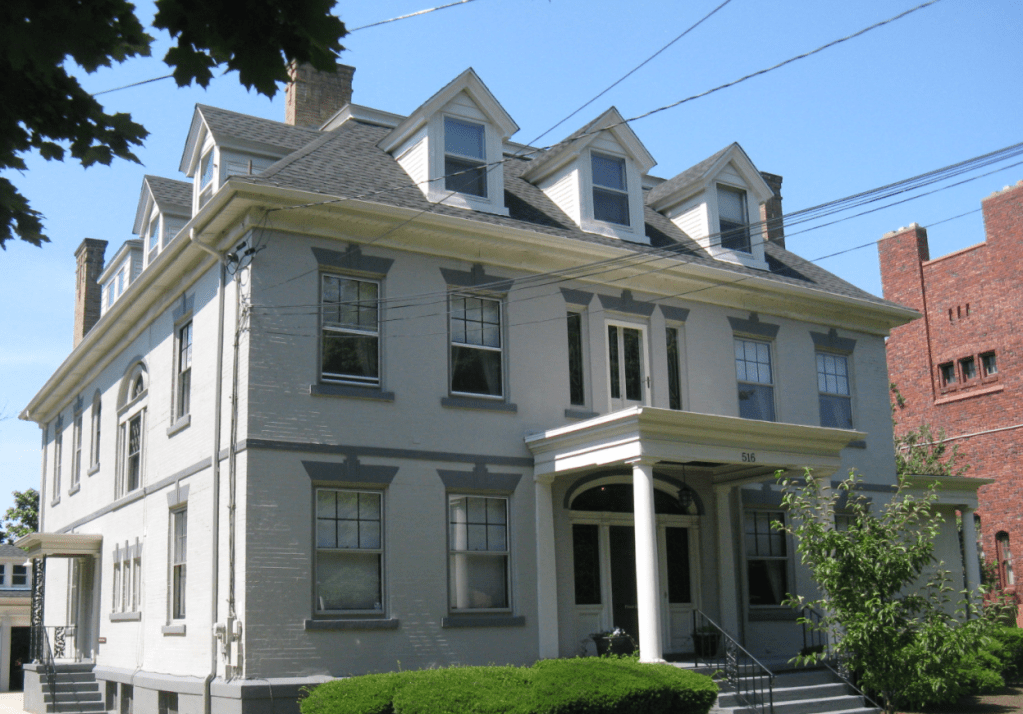
Date of Construction: 1901
Architectural Style: Georgian Revival
Defining Architectural Characteristics: Symmetrical form, multi-pane windows, hipped roof, transom window over paneled front door, pilasters at front entry, window pediments, multiple dormers, symmetrical chimneys.
History: Originally occupied by the E.A. Davis family. Edwin A. Davis was a successful State Street merchant (814 State – the MOST Erie address ever), selling wallpaper, fixtures, shades, etc. Around 1925, it became the home of William Illig, whose father, Daniel Illig, a tailor and men’s clothing store owner, built the grand Second Empire home at 21st and Peach (that is now 1020 at the Bastion). William Illig was a lawyer and one of the founding partners of MacDonald, Illig, Jones and Britton Law Firm.
Continue west on 10th Street
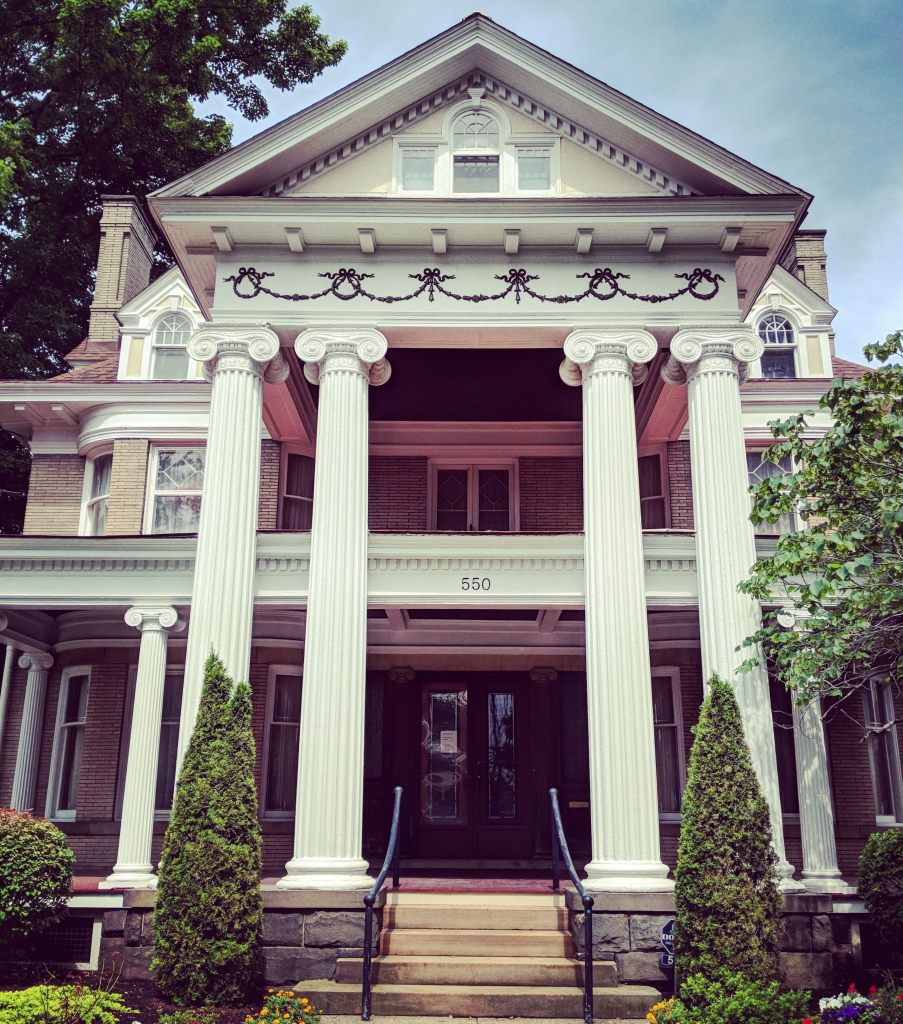
550 West 10th Street // The Schabacker House
Date of Construction: 1901
Architectural Style: Greek Revival
Defining Architectural Characteristics: Symmetrical shape, prominent columns, porch entry, decorative cornices and friezes. Note the gable turned to face the street, which is an aspect reminiscent of a Greek Temple.
History: This was once the home of Martin and Lydia Schabacker. Martin was a wholesale fruit and vegetable dealer, who ran his store “People’s Grocery” at 15th and State and later at 18th and Wayne.
Continue west on 10th then head north on Cherry and take a left onto West 9th
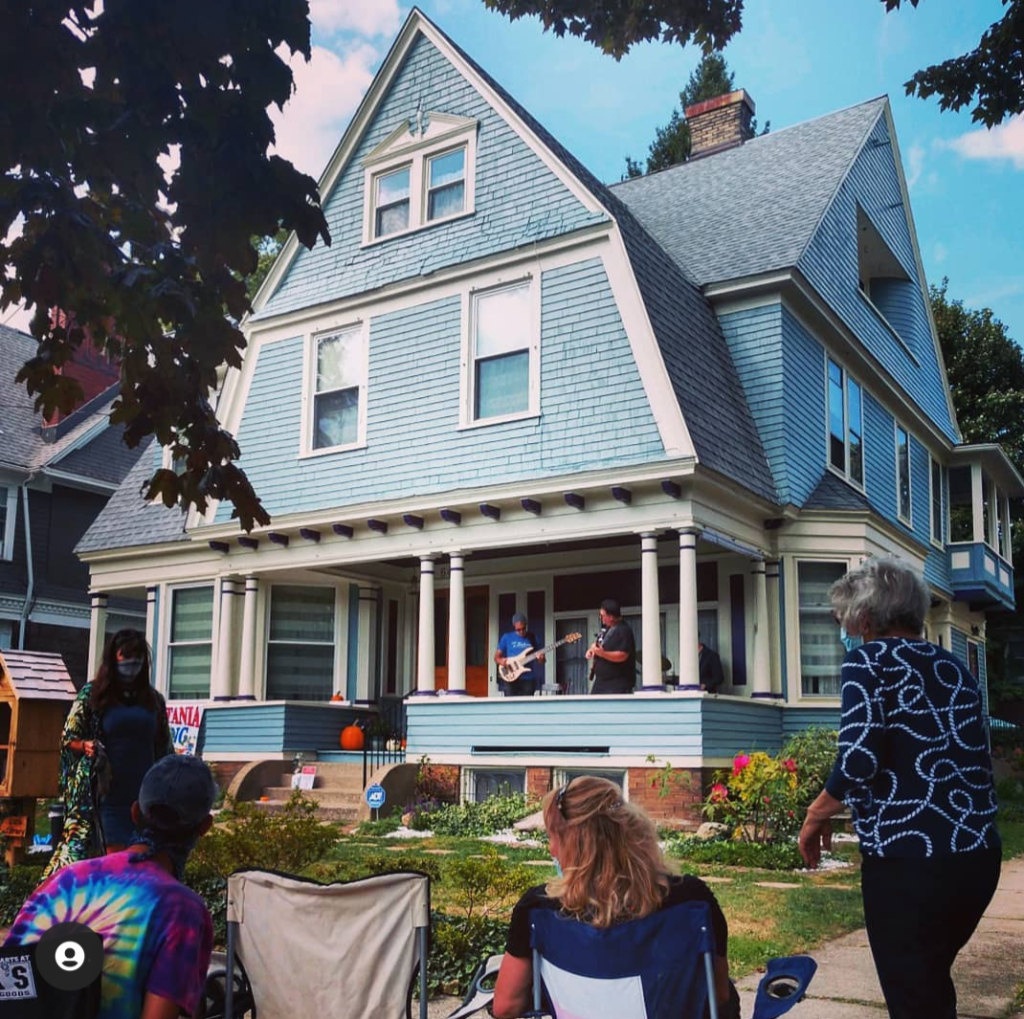
646 West 9th Street // The Jones Siegel House
Date of Construction: 1895
Architectural Style: Shingle Style
Defining Architectural Characteristics: wood cladding, asymmetry, large, imposing shapes and massing (how large the home appears), gambrel roofs with multiple gables, multiple verandas and porches, cedar shake shingling.
History: This home was originally occupied by Jesse Supplee, a civil engineer and building inspector for the City of Erie. Eventually the home was purchased by the daughter of Col. Percy Lancelot Jones, who was a U.S. Army Physician as well as the superintendent of Hamot Hospital in the 1930s, and was instrumental in the invention of the ambulance. Elizabeth Jones Siegel and her husband Charles Siegel, who was part of the J.F. Siegel Co. (coal and oil), lived in the home for the bulk of its existence, until 2007. Elizabeth died in 2010 at age 94.
Continue west to Liberty Street and make a left
912 Liberty Street // The Mayo House

Date of Construction: 1908
Architectural Style: Tudor Revival
Defining Architectural Characteristics: Half timbering, stucco exterior, steeply pitched roof with multiple asymmetrical gables, overhanging second story above a front porch, earth tones.
History: The original occupant was M.G. Mayo, who owned a luggage shop at 709 State Street and was a popular basketball player at the YMCA.
Head north back to Ninth Street and turn left/west
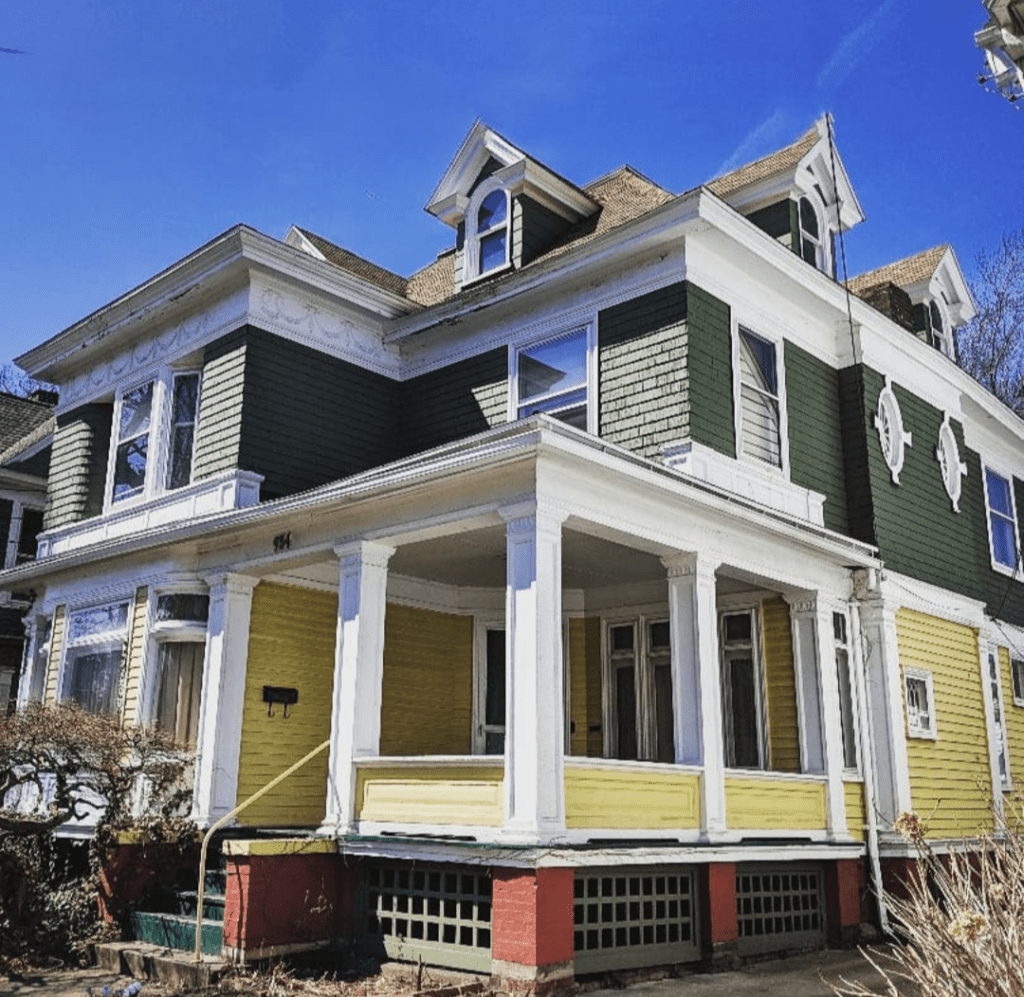
954 West 9th Street // The Wheeler Armstrong House (C. Paxton Cody)
Date of Construction: 1901
Architectural Style: Combination of Styles: Folk Victorian/American Foursquare designed by architect C. Paxton Cody
Defining Architectural Characteristics: Folk Victorian aspects: clapboard siding, front porch, two bay facade, intricate carvings. American Foursquare aspects: square, two and a half story construction, with centered dormers on all four sides.
History: This home was included on the walk to give an example of a well-known architect’s work in Erie. C. Paxton Cody designed a number of homes and buildings in Erie around the turn of the 20th Century. Some of his most well known designs are the number of Craftsman Style homes he built on Lincoln Avenue. He also designed homes and buildings in Pittsburgh and Cleveland and was the president of the PA State Association of Architects. In this neighborhood, he also designed the church (turned apartments) just south of 9th Street on Liberty (directly next door to the Tudor Revival example).
This was once the home of Jessie Wheeler and Edwin Armstrong. Jessie was a prominent high school teacher in Erie who was integral in the creation of the first PTA in Erie. She resigned amidst a bit of a scandal, as she demanded higher pay and if she didn’t receive it, she offered her resignation. Edwin was a proprietor of Ball Engine Works.
To avoid biking on 8th Street (danger danger), you can head back up to 10th Street, head east to Cherry and go north on Cherry to 8th.
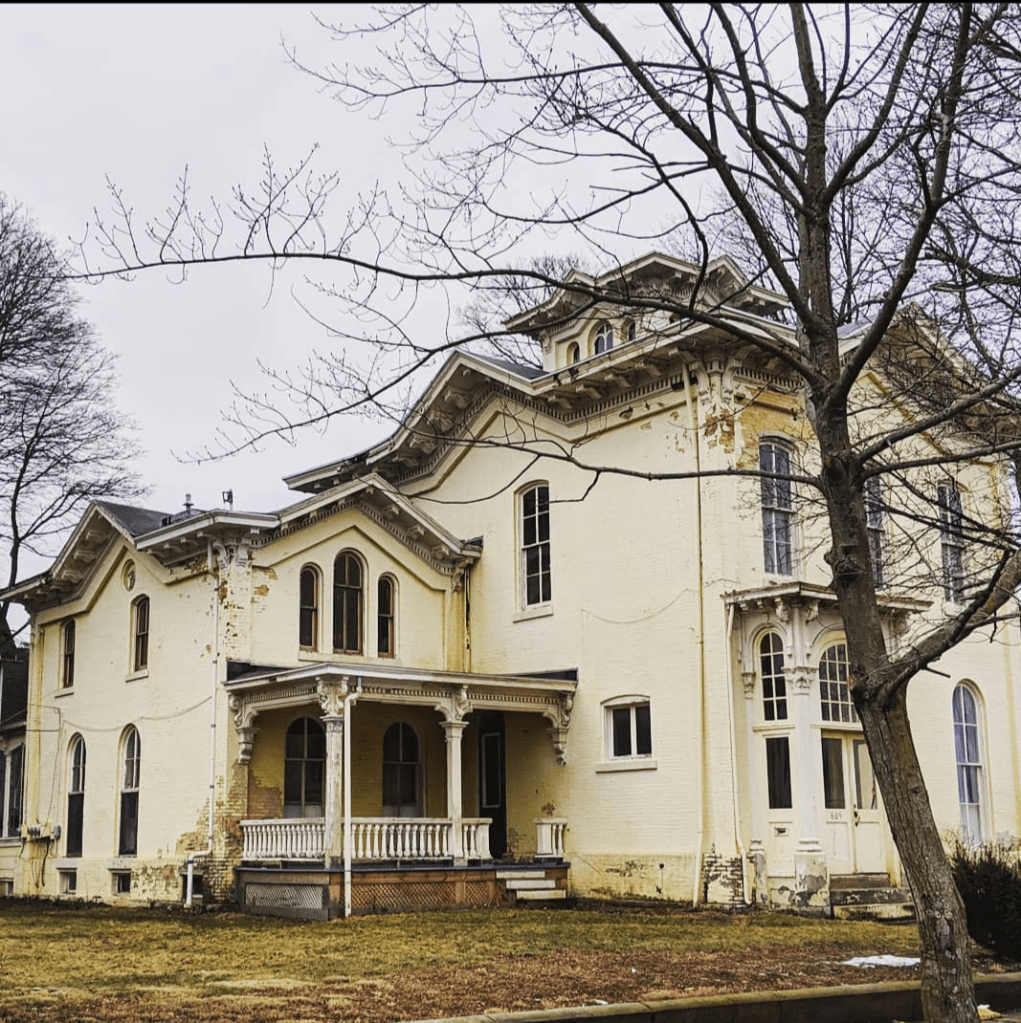
605 West 8th Street // The Thayer-Thompson House
Date of Construction: 1863
Architectural Style: Italianate
Defining Architectural Characteristics: low pitched roof, balanced symmetrical rectangular shape, wide overhanging eaves with large brackets or cornices, a square cupola (topper), arched windows, ornamented portico (doorway), window pediments.
History: This home is known as the Thayer-Thompson House and is listed on the National Register of Historic Places. The home’s namesakes: Oscar Thayer and Victory Thompson were both in the oil refinery business and built their wealth through the black gold of Titusville. Thompson ran the Erie City Oil Works, which was eventually purchased by Thayer, which he then sold to the Standard Oil Company.
From here, head north on Cherry to 7th and make a left. This is our last stop.
614 West 7th Street // The Osborne House

Date of Construction: 1908
Architectural Style: Dutch Colonial
Defining Architectural Characteristics: The most defining characteristic of a Dutch Colonial is it’s Gambrel Roof, having curved edges and spanning the length of the house. Two chimneys on either end, wood frame with cedar shake siding. (note the “clinker bricks” comprising the eastern chimney – we just learned about those!)
History: This home resides at the Southeast entrance to Garden Court, Erie’s first planned subdivision which has 27 homes all built around a shared interior courtyard. In 1906, the property of this city block was purchased and planned out by James Baldwin, and the homes on the block were built between 1908-1930. This home, the Osborne House, was among the first built in this subdivision. A.B. Osborne was a prominent attorney.
 olderieonfoot.com